

Complete Beginner's Guide for Bookkeeping 2026
If you own a business in Honolulu, Maui, Oahu, Kauai, or the Big Island, bookkeeping is not just admin work. It is the system that helps you track income, manage expenses, stay ready for taxes, and make smarter decisions before small issues turn into bigger ones.
For Hawaii business owners, bookkeeping matters even more because the state uses a General Excise Tax system instead of a traditional sales tax. Many businesses that earn income in Hawaii generally need a GET license, and periodic returns are usually due on the 20th day after the close of the filing period. Clean records make all of that far easier.
This guide explains what bookkeeping is, why it matters in Hawaii, how to build a simple system, what mistakes to avoid, and when it makes sense to hire professional help.
What is bookkeeping?
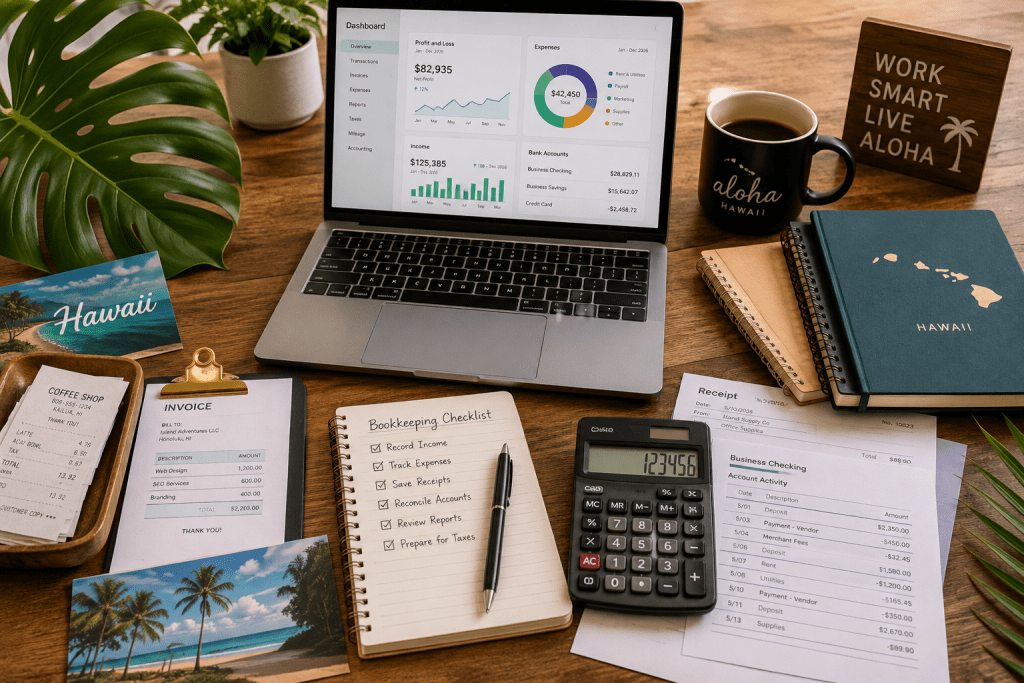
Bookkeeping is the daily or weekly process of recording your business’s financial activity. That includes sales, customer payments, bills, expenses, payroll, receipts, and bank transactions.
Bookkeeping is different from accounting. Bookkeeping focuses on recording and organizing transactions, while accounting uses that information for tax filing, financial analysis, and business planning.
Small businesses need bookkeeping because clean records help answer basic but important questions: How much money came in, what did the business spend, are customers paying on time, and is the business actually making a profit?
What is bookkeeping for small businesses in Hawaii?
Bookkeeping for small businesses in Hawaii is the process of recording and organizing income, expenses, receipts, invoices, payroll, and bank transactions so the business owner can manage cash flow, prepare for taxes, and stay compliant. In Hawaii, bookkeeping is especially important because many businesses must register for GET and keep accurate records to support tax filings and financial reporting.
Why bookkeeping is important for Hawaii small businesses
Hawaii business owners face a few bookkeeping challenges that are especially important in 2026. The biggest one is GET compliance. Hawaii’s tax system is based on a General Excise Tax rather than a traditional sales tax, so business income must be tracked carefully from the start.
That means accurate income tracking matters. If your books are incomplete, your GET reporting can become inaccurate, especially if you have multiple revenue streams, service income, or business activity across different counties.
Bookkeeping also helps Hawaii businesses deal with seasonal income swings. Tourism-related businesses, restaurants, activity companies, and local retailers may have busy months and slow months, so owners need reliable numbers to manage payroll, rent, inventory, and vendor payments.
Good books also improve visibility. When your records are current, you can review profit, check cash flow, prepare for tax deadlines, and respond faster if records are ever requested.
Lorem ipsum dolor sit amet, consectetur adipiscing elit. Ut elit tellus, luctus nec ullamcorper mattis, pulvinar dapibus leo.
Basic bookkeeping terms every beginner should know
Here are the bookkeeping terms every beginner should understand:
- Revenue is the money your business earns from selling products or services.
- Expenses are the costs of running the business, such as rent, payroll, software, and supplies.
- Assets are what the business owns, including cash, inventory, and equipment.
- Liabilities are what the business owes, such as loans, unpaid bills, or taxes.
- Equity is the owner’s stake in the business after liabilities are subtracted from assets.
- Accounts receivable is money customers still owe you.
- Accounts payable is money you owe vendors or suppliers.
- Cash flow is money moving in and out of the business.
- Profit and loss statement is a report showing income, expenses, and profit over a period.
- Balance sheet is a report showing assets, liabilities, and equity at a specific date.
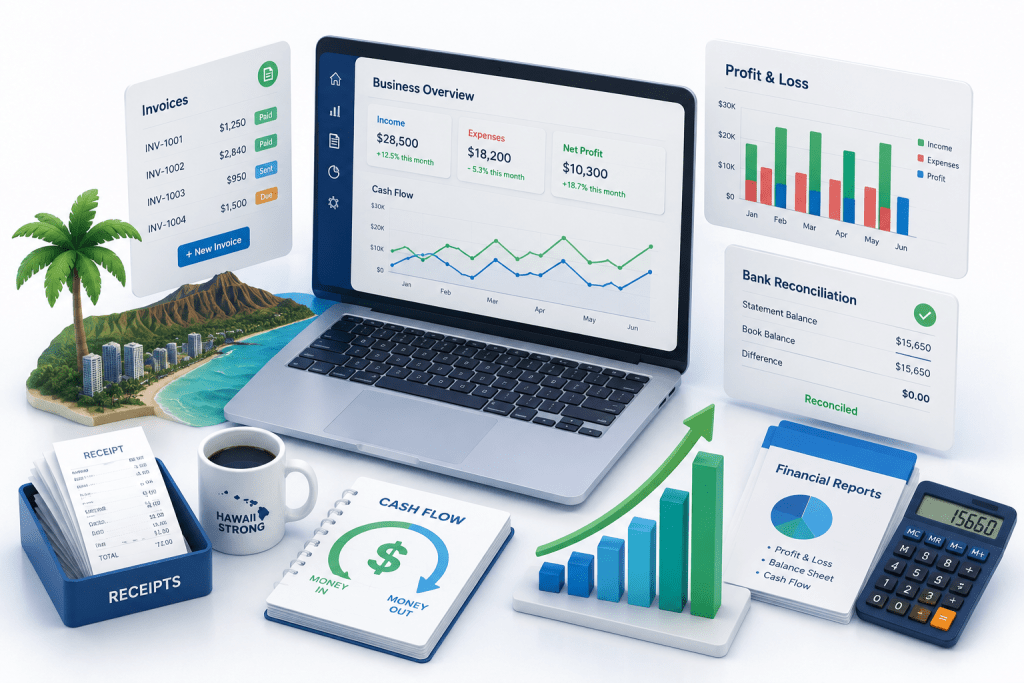
Step-by-step bookkeeping process for beginners
If you are learning how to do bookkeeping for a small business, start with this practical system.
1. Open a business bank account
The first step is to separate business and personal finances. This keeps your bookkeeping clean and makes it easier to support expenses at tax time.
2. Choose a bookkeeping method
Most small businesses use either cash basis or accrual basis bookkeeping. Cash basis records income when received and expenses when paid, while accrual basis records them when earned or incurred.
3. Track all income
Record every payment, deposit, and sale. In Hawaii, that matters even more because GET applies to gross income from business activity, so weak revenue tracking can create filing mistakes.
4. Record expenses and save receipts
Every business expense should be recorded consistently, and the receipt or invoice should be stored safely. That includes rent, software, supplies, merchant fees, fuel, insurance, and subcontractor payments.
5. Categorize transactions
Put each expense and income item in the correct category. This helps you understand where money is going, improves reports, and makes tax preparation easier.
6. Reconcile bank statements
Reconciliation means comparing your bookkeeping records to bank and credit card statements to catch missing, duplicate, or incorrect transactions. This is one of the best ways to keep your books accurate.
7. Review reports monthly
At minimum, review your profit and loss statement, balance sheet, and cash flow position every month. Good records help you monitor progress, prepare financial statements, and support items reported on tax returns.
8. Prepare for taxes year-round
Do not wait until tax season to organize your books. Monthly bookkeeping makes GET filing, payroll reporting, and year-end tax preparation much easier.
Single-entry vs double-entry bookkeeping
Single-entry bookkeeping records transactions once, usually as income or expense. Double-entry bookkeeping records both sides of each transaction, which creates stronger reporting and better checks for accuracy.
For very small businesses, single-entry may seem easier. But most growing businesses benefit from double-entry bookkeeping because it gives better visibility into assets, liabilities, and overall financial health.
Best bookkeeping software for Hawaii small businesses
The best software depends on your business type and how much support you need.
QuickBooks
QuickBooks is a strong choice for small businesses that want invoicing, expense tracking, reporting, and accountant collaboration in one system. It is widely used, which also makes it easier to find bookkeeping support.
Xero
Xero is popular with cloud-first businesses and service companies that want a clean interface and strong app integrations. It can work well for startups, agencies, and businesses with remote workflows.
Wave
Wave is often a good starting option for freelancers and very small businesses with simple bookkeeping needs. It is usually best for low transaction volume and straightforward income and expense tracking.
FreshBooks
FreshBooks works well for service businesses that send frequent invoices, such as freelancers, consultants, and solo professionals. It is simple and easy to use, though some businesses may outgrow it as operations become more complex.
How Hawaii General Excise Tax affects bookkeeping
This is the most important Hawaii-specific issue to understand. Hawaii uses General Excise Tax instead of a traditional sales tax. The tax is generally imposed on business activity and gross income, with county surcharge rules that can affect the final amount in some locations.
That changes bookkeeping in a big way. Instead of treating tax like a simple checkout add-on, business owners need clear records showing gross income, transaction details, and consistent reporting totals.
Bookkeeping matters for GET compliance because you need to track taxable income accurately, prepare periodic returns, and support the amounts reported.
Example: A Honolulu café should track dine-in sales, catering, delivery app payouts, refunds, and merchant fees separately each month. That gives the owner a clearer picture of revenue and makes GET reporting more accurate.
Common bookkeeping mistakes small businesses make
Here are the mistakes that cause the most trouble:
- Mixing personal and business finances, which makes records messy and harder to defend.
- Missing receipts and invoices, which weakens expense support.
- Ignoring bank reconciliation, which lets errors stay hidden.
- Delaying bookkeeping for months, which creates tax-season chaos.
- Categorizing expenses incorrectly, which damages report accuracy.
- Failing to track cash flow, especially in seasonal Hawaii industries.
- Trying DIY tax filing without clean books.
DIY bookkeeping vs hiring a professional bookkeeper
DIY bookkeeping can work when the business is simple, transactions are limited, and the owner updates the books consistently. The IRS allows business owners to use any recordkeeping system suited to the business as long as it clearly shows income and expenses.
But outsourcing often makes sense once the business gets busier or more complex. A professional bookkeeper can save time, improve accuracy, keep records tax-ready, and help avoid Hawaii-specific GET mistakes.
This is especially useful for restaurants, contractors, tourism businesses, e-commerce sellers, and owners with payroll, multiple revenue streams, or overdue books.
Monthly bookkeeping checklist
Use this checklist every month:
- Download bank and credit card statements.
- Record all income and customer payments.
- Enter and categorize all expenses.
- Save receipts and invoices.
- Reconcile bank and credit card accounts.
- Review unpaid customer invoices.
- Review upcoming bills and vendor payments.
- Check payroll and payroll records.
- Review GET-related revenue totals.
- Run profit and loss and balance sheet reports.
Year-end bookkeeping checklist
At year-end, make sure you:
- Confirm all accounts are reconciled.
- Clean up uncategorized transactions.
- Match documentation to major expenses.
- Review accounts receivable and accounts payable.
- Check owner draws, loans, and equity entries.
- Confirm GET filings are complete.
- Organize payroll records.
- Prepare clean reports for tax filing.
How Amazing Financial Solutions can help
Many Hawaii business owners do not struggle because bookkeeping is impossible. They struggle because they are busy running the business and cannot keep the books updated consistently.
Amazing Financial Solutions can help with monthly bookkeeping, cleanup bookkeeping, payroll, outsourced bookkeeping, tax-ready financials, and regular reporting that gives owners a clear view of their numbers. That kind of support is especially valuable for Hawaii businesses dealing with GET compliance, seasonal revenue, and growing operations.
Need help managing your business finances in Hawaii? Contact Amazing Financial Solutions today for professional bookkeeping support.

FAQ
How much does bookkeeping cost in Hawaii?
Bookkeeping costs vary based on transaction volume, payroll complexity, cleanup needs, software, and whether you need monthly reporting. Simple freelancer books cost far less than multi-location retail, restaurant, or contractor bookkeeping.
Do I need a bookkeeper for my small business?
Not every small business needs a full-time bookkeeper, but every business needs a reliable bookkeeping system that clearly tracks income, expenses, and taxes. The IRS specifically requires a recordkeeping system that supports tax reporting, and Hawaii businesses often need even more discipline because of GET filing obligations.
Is bookkeeping required by law?
The law may not require a special bookkeeping format in most cases, but the IRS says businesses must keep records that clearly show income and expenses and support deductions on tax returns. So while a specific spreadsheet or software may not be mandatory, keeping proper records absolutely is.
How often should I update my books?
At a minimum, update bookkeeping monthly. Weekly is even better for businesses with heavy transaction volume, payroll, inventory, or tight cash flow.
What records should I keep?
The IRS says businesses should keep receipts, invoices, deposit records, paid bills, payroll records, canceled checks, and other documents that support the entries in the books and tax returns. Employment tax records should generally be kept for at least four years.
What is the difference between bookkeeping and accounting?
Bookkeeping records transactions and maintains the financial data. Accounting uses that data for analysis, tax preparation, financial statements, and advisory work.
What is the best bookkeeping software for small businesses?
There is no single best option for everyone. QuickBooks is often best for all-around small business use, Wave works for simple low-budget setups, FreshBooks is strong for invoicing, and Xero is good for cloud-first operations, but the right choice depends on your business model and reporting needs.
How does Hawaii GET tax work?
Hawaii’s General Excise Tax is a tax on business activity rather than a traditional sales tax on the customer. Hawaii generally uses GET on business income, and businesses may choose to visibly pass on the tax to customers.
Do I need a GET license in Hawaii?
The Hawaii Department of Taxation says anyone who receives income from conducting business activities in the state generally must register for a General Excise Tax license, and the fee is a one-time registration fee.
How often do Hawaii businesses file GET returns?
Periodic GET returns for monthly, quarterly, and semiannual filers are generally due on the 20th day of the month after the period ends, and annual returns for calendar-year filers are generally due on April 20.
What happens if I have no income for a filing period?
The Hawaii Department of Taxation says license holders must still file periodic and annual returns even if no tax is due and no gross income was earned during the period.
Can I do bookkeeping myself?
Yes, many owners start with DIY bookkeeping. It can work well if the business is simple, transactions are low-volume, and records are updated regularly, but complexity often increases quickly once payroll, inventory, or Hawaii tax compliance enter the picture.
What are the biggest bookkeeping mistakes small businesses make?
Common mistakes include mixing personal and business finances, skipping reconciliations, delaying bookkeeping, losing receipts, and relying on incomplete records for tax filing.
Why is cash flow management important in Hawaii?
Seasonal demand, tourism cycles, and higher operating costs can create bigger swings in cash flow for Hawaii businesses. Good bookkeeping helps owners see those patterns early and plan around them.